Saturday, April 6, 2013

18-15-4: Three Out Of Four Ain't Bad ...

It ain't bad but, of course, the Rangers probably could have taken four out of four from the home-and-home with the Penguins. Then again, let's face it, that wasn't going to happen - not with this head coach, not with this team. Still, the Blueshirts played a capable road game at Consol before falling in a skill competition.

Kind of appropriate, isn't it? The Rangers not having - or more appropriately, displaying - the skills to win?

The carefree, fun Rangers that annihilated the Pens Wednesday were replaced by a typical Tortorella troupe that mucked and grinded their way though the final buzzer and beyond. And that was good enough to earn a much-needed point against the top team from the LEast. Torts' counterpart Dan Bylsma acknowledged the absence of his top player and top two defensemen, and had his team play a tighter game. But, even so, that depleted squad still managed to get great chances seemingly at will and controlled the tempo.

That is the problem. Tortorella's personal aggression doesn't translate to his game plan - his philosophy has been to respond to the opposition rather than to impose his will upon it. Block shots, try not to take penalties, take what the other guys give you, limit forechecking to maintain optimum positioning, bequeath the blue line but hold the hash marks, minimize mistakes. That's not the way to win in the post-'04 lockout NHL. When Torts' team went out and just played on Wednesday they forechecked, they pressed, they threw caution to the wind and let Hank hold down the fort. Now the King is back behind his walls, walls that are as much a hindrance as a help. Sad.

Just a few Late Hits:

*Torts was back to himself, going heavy on his usual horses. Step skated for 24 minutes and took 28 faceoffs (he won seven). Brassard, who so impressed in his debute, played 14 minutes and took eight draws (winning six). Del Zaster 26 minutes, John Moore 10. The fourth line saw around seven.

*Should the Rangers squeak into the postseason and face Pittsburgh, the series could be quite the bloodbath with the Pens seeking Del Zaster's head. But would Torts and the Blueshirts battle - and eventually prevail - the way Philly did last year?

*Step was miserable at faceoffs for most of the match but man, did he win one at the right time. And that was one lightning-fast release by Nash ... Gabby likely would have set himself and waited too long.

*Do we give Boyle credit for continually trying or do we slam him for blowing big chances? Yeah, we slam him. Too slow, cement hands, cement head. Especially since every little kid is taught that the numbers on the back of the jersey are a stop sign, you don't aim for them when laying a body check (at least with the ref watching).

*Really wish Douglas Murray had become a Ranger.

*Hope this second honeymoon with Zuke never ends. He's so much fun to watch play.
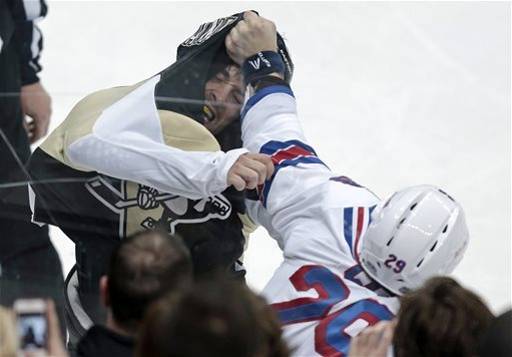
*Engelland was 19-4-1 over his 25 previous fights, including a decision over Clowe in a wild bout last season. The rematch was a good one, with the big guys trading some big punches. It's nice that Clowe accounted himself well but that fight was for Engy. The wise defenseman knew he needed that early bout for his team, to show they weren't going to be smacked down for a second straight game. Seeing as the Rangers didn't exactly set the world on fire in the first 10, it's understandable that Clowe entertained the dance invitation.

*PHW Three Stars:
3-Henrik Lundqvist - 26 saves.
2-Jussi Jokinen - one regulation goal, one shootout goal.
1-Marc-Andre Fleury - 34 saves.

Scotty Hockey Three Stars:
3-Fleury - Not the same sieve that let six past him on Wednesday.
2-Hank - Some quality stops by the King.
1-Jokinen - New team syndrome struck for everyone else who was dealt at the deadline, so it was inevitable. 


 18-15-4: Three Out Of Four Ain't Bad...


In the world of sports, every season is a rollercoaster ride filled with highs, lows, and unforgettable moments. The record of 18-15-4 encapsulates a season in which a team achieved a remarkable feat—winning three out of four games in a crucial stretch. In this article, we will delve into the thrilling narrative of this season, explore the significance of winning three out of four, and answer frequently asked questions to provide a comprehensive understanding of this noteworthy achievement.

I. The Season's Journey

The season began with high hopes and aspirations for the team, as they set out to conquer the challenges that lay ahead. Each game brought its own unique set of trials and triumphs, contributing to the team's overall record of 18-15-4.

Early Season Challenges: The team faced early season challenges, including injuries and adapting to new strategies. These hurdles tested their resilience and determination.

Turning Points: Throughout the season, there were turning points where the team's performance either surged or faltered. These pivotal moments shaped their journey and aspirations.

II. The Crucial Stretch: Three Out Of Four

The turning point of the season came during a critical stretch of games where the team achieved a remarkable feat—winning three out of four contests. This achievement was a testament to their skill, determination, and teamwork.

Stunning Victory: The team began the stretch with a stunning victory that showcased their ability to overcome adversity. It was a game that left fans exhilarated and full of hope.

Building Momentum: The consecutive victories built momentum, fueling the team's confidence and determination. Players were firing on all cylinders, and the chemistry on the ice was palpable.

Resilience in Defeat: Even in their lone loss during this stretch, the team displayed resilience and fought valiantly. It was a testament to their character and refusal to back down.

III. The Significance of Winning Three Out Of Four

Winning three out of four games in this crucial stretch held immense significance for the team and its fans.

Boost in the Standings: The victories catapulted the team up the standings, positioning them as serious contenders in the league. It was a remarkable ascent that invigorated fans.

Confidence and Belief: The wins instilled a sense of confidence and belief in the team's abilities. Players knew they could compete at the highest level and were ready to take on any challenge.

Fan Enthusiasm: Fans celebrated the team's success with boundless enthusiasm, filling arenas with excitement and optimism. The games became a collective experience of joy and celebration.

IV. FAQ: Answering Your Questions

How does a team maintain momentum during a winning streak?

Maintaining momentum during a winning streak requires a combination of physical and mental preparation. Players must stay focused, continue practicing diligently, and not become complacent.
What role does coaching play in a team's success during a crucial stretch of games?

Coaching plays a vital role in strategy development, motivation, and adjustments during games. Coaches provide the guidance and leadership necessary to maximize a team's performance.
Can a team's performance during a crucial stretch impact their chances in the postseason?

Yes, a team's performance during a crucial stretch can significantly impact their postseason prospects. Building momentum and confidence can carry into the playoffs, making them more formidable competitors.
How do fans contribute to a team's success?

Fans contribute to a team's success by providing unwavering support, creating a passionate atmosphere in arenas, and motivating players. Their enthusiasm and loyalty are invaluable.
V. Conclusion

The record of 18-15-4 is a testament to the captivating nature of sports, where every game and every stretch of the season carries the potential for greatness. Winning three out of four games during a crucial period was not just a statistical achievement; it was a manifestation of the team's determination, resilience, and skill.

As fans and enthusiasts relive this remarkable stretch, they are reminded that sports have the power to inspire, unite, and elevate the human spirit. The victories during this period serve as a source of pride, a symbol of hope, and a testament to the enduring magic of competition. In a world filled with challenges, sports stories like this one remind us of the beauty and excitement that can be found on the ice, where teams achieve remarkable feats and inspire us all.


Friday, April 5, 2013

18-15-3: No Coaching Is Good Coaching

In a day and age when teams are scouted and video is poured over relentlessly in preparation for the next opponents, Wednesday night was a nice reminder that sometimes it is just best to go out and play.

Three new players were integrated into the Rangers lineup and the team exhibited some of their best hockey of the season. There was no ridiculous worries about gap control, shot blocking and 15 passes for every shot. The Blueshirts just played. And, man, did it work out. They destroyed the NHL's favourite sons to the tune of a 6-1 curb stomping.

The Penguins on Wednesday were much like the Flyers last week - a team reeling from important injuries with a sieve for a goaltender. And the Rangers were able to take full advantage and grab two points from a division rival. Adding the new guys - and Tortorella's shocking willingness to use them - meant that just one player saw less than 10 minutes of ice time (Asham) and that all four lines were able to play their best, shift in and shift out. Amazing how things work out when that happens.

Torts has shown that he can't adapt his style to the style of the team so Sather dealt Gabby and some draft picks for an insta-fix, a buncha grinders to play the roles the coach can cope with. The new guys accounted themselves quite well, we just have to wonder how they will do once they get whipped into submission like the rest of the Ranger horses.

Late Hits:

*Ryane Clowe now has as many goals as he has extra "E"s in his name. The goals themselves were wonderful to watch but it was his willingness to hit and battle in the slot that were really delightful - very necessary qualities that were missing thusfar this season.

*Brian Boyle. Shocked he wasn't traded, figured it was his faceoff ability that saved him ... and then he spent the game on the right wing. Bizarre, but it worked out. He was still pillow-soft but his feed to Moore was outstanding.

*Moore's play throughout the night was wonderful to eyes tired of seeing the mistake factories that have been Hamrlik, Stralman and Eminger.

*Brassard looked like a miracle worker - he had a goal and two assists on the power play. The Ranger power play. He displayed smooth skating, an ease with the puck and skill at the dot ... everything we've wanted to see from Richard$.

*So my Tw-enemy Asham was pulled away from Matt Cooke by a linesman so he decided to fight Tanner Glass, using the excuse of a shot after a whistle. So it is ok to fight for a minor 'code' infraction but not when McDonagh nearly gets killed by MaxPac or when Hank is hammered? Keep in mind Asham fought Glass earlier this season to draw and was looking to win Round 2. Can't wait for Dorsett to heal and render Asham even more useless.

*Too tired to look it up but just nine shot blocks by the Blueshirts - a season low? So maybe staying on their feet and in position is something that is helpful? Just a thought.

*Two poor first period penalties by McD and DZ. Two too many.

*Kreider and Miller are thankfully back in the bus league so they can get some icetime and improve. Haveta wonder if Hagelin needs to go to Hartford too. Something has to happen, he has to get some chemistry with capable linemates or just find some confidence because one goal in his last 17 games is not good enough.

*No complaints but Malkin and Iginla were quiet. Figured Geno would at least try to injure someone, as he often does. As a good friend observed, Pittsburgh REALLY misses Kris Letang. Sure Sid's absence hurts, but Letang is the real lynchpin for Bylsma's system.

*PHW Three Stars:
3-Brad Richards - one goal and two assists.
2-Derek Brassard - one goal and three assists.
1-Ryane Clowe - two goals and one assist.

Scotty Hockey Three Stars:
3-Moore - No Hamrlik! Capable puck movement! A goal from a Blueshirt blueliner!
2-Brassard - Strange to see No. 16 out there again, but if Brassard keeps playing like this he may end up as loved as the last guy who wore it. (I doubt it.)
1-Clowe - Sure he won't be scoring every night but he has a big body and he isn't afraid to use it. Tremendous. Maybe Boyle will learn and emulate? Please? 


 18-15-3: No Coaching Is Good Coaching


In the realm of sports, coaching is often hailed as an essential element of a team's success. Coaches provide guidance, strategy, and motivation to their players, aiming to unlock their full potential. However, there are instances where a team manages to thrive even in the absence of a head coach. The record of 18-15-3 serves as a captivating case study where the mantra "No Coaching Is Good Coaching" came to life. In this article, we will delve into the intriguing narrative of this season, explore the unique circumstances that led to success, and answer frequently asked questions to provide a comprehensive understanding of this remarkable achievement.

I. The Season's Unconventional Beginnings

The season commenced under unconventional circumstances when the team found itself without a head coach. The absence of a coaching figurehead created an atmosphere of uncertainty, prompting questions about how the team would fare.

Leadership Vacuum: The departure of the head coach left a leadership vacuum within the team. Players and assistant coaches were faced with the challenge of stepping up and filling this void.

Team Autonomy: With no head coach to provide daily instructions and strategies, players found themselves in a unique position. They were entrusted with a higher degree of autonomy in decision-making on and off the ice.

II. The Players Take Charge

In the absence of a head coach, the team's players took charge of their destiny. They embraced the responsibility of shaping their own strategies, fostering unity, and motivating each other to perform at their best.

Player-Led Strategies: The team adopted a player-led approach to developing game strategies. Players pooled their collective knowledge and experience to devise effective game plans.

Intra-Team Accountability: Players held themselves accountable for their performance, fostering a culture of responsibility and commitment. They challenged each other to continually improve and excel.

Team Unity: The absence of a head coach encouraged players to bond and support one another. Team unity became a cornerstone of their success, with players rallying behind a shared goal.

III. The Unique Circumstances of Success

The team's success during this season unfolded against a backdrop of unique circumstances.

Player Expertise: Several veteran players on the team possessed extensive knowledge of the game. Their experience and insight played a pivotal role in crafting effective strategies.

Assistant Coaches' Roles: Assistant coaches stepped into expanded roles, providing invaluable support and guidance. They worked collaboratively with players to execute game plans.

Embracing Innovation: The team embraced innovation and unconventional tactics. They were open to trying new strategies and approaches that might not have been considered under traditional coaching.

IV. FAQ: Answering Your Questions

How common is it for a team to succeed without a head coach?

It is relatively uncommon for a team to succeed without a head coach in professional sports. Coaching is traditionally seen as an integral part of a team's structure and success.
What skills and attributes do player-leaders need to succeed in such circumstances?

Player-leaders need strong communication skills, a deep understanding of the game, the ability to inspire and motivate teammates, and a commitment to the team's success.
What is the role of assistant coaches when there is no head coach?

In the absence of a head coach, assistant coaches often assume greater responsibilities. They may help with game planning, strategy development, and player development while working closely with players.
Can a player-led approach be successful in the long term?

While a player-led approach can yield short-term success, it is often challenging to sustain over an entire season or multiple seasons. Head coaches provide essential leadership and structure for long-term success.
V. Conclusion

The record of 18-15-3, with its mantra of "No Coaching Is Good Coaching," represents a unique and inspiring chapter in the world of sports. It demonstrates the resilience, adaptability, and leadership qualities that athletes possess when faced with unconventional circumstances.

As fans and enthusiasts reflect on this exceptional season, they are reminded that the essence of sports lies not only in the strategies devised by coaches but also in the heart and determination of the players themselves. It is a testament to the power of unity, innovation, and self-belief in achieving success. In a world where coaching is often celebrated, this remarkable achievement stands as a reminder that sometimes, the best leaders are the ones who lace up their skates and step onto the ice.


Wednesday, April 3, 2013

Taking a (Very) Early Look at Next Season's Roster

Now that we have had 4 or 5 days to heal after the tough loss to Union, I thought it would be a good idea to take a look at what next year's roster could potentially look like. Before I do that though, I'd like to congratulate Patrick Brown on being named captain for next years team. He will certainly be an outstanding leader on and off the ice. I think it's a great selection by the players. Also, congrats to Billy Arnold and Isaac Macleod on being named his associate captains.

So, before I reveal what I think the lineup could look like, I need to adress the early departures. As of today, no one has left the school and it is my expectation that everyone will stay. A source indicated today that he thinks that it is "very likely" that Mike Matheson returns to Chestnut Hill for one more year. As for Kevin Hayes, I would guess that there is a very slim chance that he leaves, mainly because of his leg. I think Chicago will want to see how he comes back from the injury. Of the three, I would label Johnny G as the biggest threat to leave but he did say after Saturday's game that he is really looking forward to playing with his brother Matt next season. In the end, I think they all return.

Let's look at who we have coming in.

Forwards- Cangelosi, Gilmour, Calnan, Gaudreau, McGlynn, Richardson and Fitzgerald.

Defense- Santini, McCoshen, and Savage

Goalie- Thatcher Demko

At first glance, I think our defense is going to among the best in the country next season. Santini and McCoshen are two of the biggest defensive recruits in the country so I expect them to come in right away and play lots of minutes. As for the 6th defensive spot, I think it will probably go to Savage but Jeke or Sullivan might have an outside shot at landing it. He is a good sized defenseman that has supposedly good feet and can move the puck well.

Up front, it all depends on who stays and who goes. There is a very good chance that both Gaudreau and Hayes both stay and if that is the case, I think BC is going to have a much deeper forward lineup than they did this season. I expect that Gilmour, Calnan, Richardson, Fitzgerald, and Cangelosi will all start right away but I'm not quite sure about M.Gaudreau and Connor McGlynn.

Here are my (way to early) line projections for next October

Johnny Gaudreau- Billy Arnold- Danny Linell

Kevin Hayes- Chris Calnan- Austin Cangelosi

Ryan Fitzgerald-Adam Gilmour- Quinn Smith

Destry Straight- Pat Brown-Brendan Silk/Matt Gaudreau

Defense

Mike Matheson-Steve Santini

Ian McCoshen- Isaac Macleod

Teddy Doherty-Scott Savage

Goalie 

Thatcher Demko


 Taking a (Very) Early Look at Next Season's Roster


In the world of sports, one season's end marks the beginning of anticipation for the next. As the curtain falls on a season filled with excitement, triumphs, and heartbreaks, fans and analysts turn their attention to the future. In this article, we will take a (very) early look at next season's roster, exploring the factors that will shape it, identifying key players to watch, and answering frequently asked questions to provide a comprehensive preview of what lies ahead.

I. The Offseason Shuffle

The period between seasons is a time of transition and change. It's when teams make pivotal decisions regarding their rosters, coaching staff, and strategies.

Player Contracts: The offseason is marked by contract negotiations, extensions, and free-agent signings. These decisions impact a team's roster composition.

Draft Picks: The annual draft is a key event where teams select promising young talent to bolster their rosters.

Coaching Changes: Some teams opt for coaching changes, which can bring about shifts in playing styles and strategies.

II. Key Departures and Arrivals

Every offseason brings with it the potential for significant roster changes. Key players may depart for new opportunities, while newcomers can inject fresh talent into the team.

Departures: Teams may lose veteran players to retirement, free agency, or trades. The departure of influential players can create voids in leadership and skill.

Arrivals: On the flip side, teams acquire new talent through trades, free-agent signings, or rookie drafts. These additions can bring excitement and promise.

III. Emerging Stars and Seasoned Veterans

Next season's roster often features a blend of emerging young talents eager to make their mark and seasoned veterans providing leadership and experience.

Emerging Stars: Young players who showed promise in previous seasons may take on more prominent roles. Their development and performance can be a focal point for fans and analysts.

Seasoned Veterans: Established players with a track record of success provide stability and leadership. Their presence can be instrumental in mentoring younger teammates.

IV. Team Identity and Strategy

A team's roster is not just a collection of individuals but a cohesive unit with a shared identity and strategy. Coaches play a pivotal role in shaping this identity.

Playing Style: The roster often dictates the team's playing style, whether it's a fast-paced offense, a defensively focused approach, or a balanced combination.

Tactical Adjustments: Coaches tailor their strategies to the strengths and weaknesses of the roster. The offseason provides an opportunity to fine-tune these tactics.

V. Frequently Asked Questions (FAQs)

How does salary cap management affect roster decisions in the offseason?

Salary cap constraints influence decisions about contract negotiations and free-agent signings. Teams must balance their budgets while trying to assemble competitive rosters.
What is the significance of rookie draft picks in shaping the roster?

Rookie draft picks are vital for infusing fresh talent into the roster. Young players with potential can become key contributors in the future.
How do teams address positional needs during the offseason?

Teams evaluate their positional needs based on the strengths and weaknesses of the current roster. They may target free agents or make trades to address gaps.
What factors influence a team's choice of coaching staff during the offseason?

Teams may change coaching staff to align with their vision and goals. Factors such as coaching philosophy, experience, and compatibility with players play a role.
VI. Conclusion

Taking a (very) early look at next season's roster is an exciting and vital part of the sports calendar. It's a time when fans, players, and analysts engage in spirited discussions and predictions about what the future holds. While the roster is still taking shape, the anticipation and optimism for the upcoming season are palpable.

As we eagerly await the next season, we recognize that the roster is more than just a list of names; it represents the hopes and dreams of fans and the dedication and talent of athletes. It's a dynamic entity that evolves and adapts, and it's the foundation upon which future victories and memories will be built.


Johnny G Named Hobey Hatrick Finalist

Boston College sophomore forward Johnny Gaudreau has been named one of three finalist for the Hobey Baker award for the nation's top colligate hockey player. Boston College has two previous Hobey Winners, Mike Mottau (2000) and David Emma (1991). The Eagles have had numerous runner-ups such as Brian Gionta (a couple of times) and Nathan Gerbe.

Congrats to Johnny and best of luck in Pittsburgh !

I'll have an (extremely) early preview of what I think next year's lineup will look like tonight.


 Johnny G Named Hobey Hatrick Finalist


In the world of college hockey, few accolades carry as much prestige and honor as the Hobey Baker Award. It is an accolade reserved for the most exceptional players, those who not only excel on the ice but also exemplify the highest standards of character and sportsmanship. In this article, we celebrate the remarkable achievement of Johnny G, who has been named a Hobey Hatrick finalist. We will delve into the significance of this nomination, explore Johnny G's outstanding career, and answer frequently asked questions to provide a comprehensive understanding of this prestigious honor.

I. The Hobey Baker Award

The Hobey Baker Award is often referred to as college hockey's most prestigious individual honor. Named after the legendary hockey player and World War I hero Hobey Baker, it recognizes the top player in NCAA Division I men's ice hockey.

Criteria for Selection: The award considers not only a player's on-ice performance but also their character, integrity, and sportsmanship.

Previous Winners: The list of previous Hobey Baker Award winners includes some of the greatest names in hockey, both at the collegiate and professional levels.

II. Johnny G: A Career in Excellence

Johnny G's nomination as a Hobey Hatrick finalist is a testament to his extraordinary career in college hockey. From his earliest days on the ice to his current standing as a finalist, Johnny G's journey has been marked by excellence.

Youth Hockey: Johnny G's passion for hockey was ignited at a young age. He honed his skills in youth leagues and demonstrated exceptional promise.

Collegiate Career: Johnny G's collegiate career was marked by consistently outstanding performances. He became a pivotal player for his team, contributing not only with goals and assists but also with leadership and sportsmanship.

Statistical Achievements: Johnny G's statistical achievements are a testament to his prowess on the ice. He has consistently ranked among the top scorers in college hockey.

III. The Significance of the Hobey Hatrick Finalist Nomination

Johnny G's nomination as a Hobey Hatrick finalist is significant for several reasons.

Recognition of Excellence: Being named a finalist for the Hobey Baker Award is recognition of Johnny G's exceptional talent, dedication, and contributions to his team and college hockey.

Prestige of the Award: The Hobey Baker Award is highly prestigious, and being named a finalist is a remarkable achievement in itself.

Character and Sportsmanship: The award places a strong emphasis on character and sportsmanship, making it a tribute to Johnny G's integrity both on and off the ice.

IV. Johnny G's Impact Beyond the Ice

Johnny G's influence extends far beyond his impressive statistics and on-ice performances.

Leadership: Johnny G has been a leader both on and off the ice. His work ethic, determination, and commitment to his team have set an example for his teammates.

Mentorship: Younger players have benefited from Johnny G's mentorship, learning valuable lessons about the game and life.

Community Engagement: Johnny G has often engaged with the community, participating in charitable activities and serving as a role model for aspiring young hockey players.

V. FAQ: Answering Your Questions

What are the criteria for selecting the Hobey Baker Award winner?

The criteria include on-ice performance, character, integrity, and sportsmanship. The award aims to recognize the "complete" college hockey player.
Who votes for the Hobey Baker Award winner?

The Hobey Baker Award winner is selected through a combination of fan voting, a selection committee, and input from NCAA Division I head coaches.
What is the significance of the Hobey Baker Award in a player's career?

The Hobey Baker Award is a prestigious honor that often opens doors to professional opportunities in hockey. It is also a recognition of a player's character and contributions to the sport.
How does the nomination process for the Hobey Hatrick finalist work?

The Hobey Hatrick finalists are selected based on their performance throughout the season and recommendations from a selection committee. It is an elite group of players who have excelled in college hockey.
VI. Conclusion

Johnny G's nomination as a Hobey Hatrick finalist is a celebration of excellence, character, and sportsmanship. It is a recognition of his extraordinary contributions to college hockey and an acknowledgment of the impact he has had on the game and its community.

As fans and enthusiasts eagerly await the announcement of the Hobey Baker Award winner, they are reminded of the enduring allure of the sport and the inspiring stories of players like Johnny G, who not only excel on the ice but also embody the values and spirit of hockey. Johnny G's journey is a testament to the power of dedication, leadership, and the pursuit of excellence, and his nomination as a finalist is a well-deserved honor that will be celebrated by the entire hockey community.


Tuesday, April 2, 2013

Ryane Clowe Reactions

Just throwing out some quick hits on the Rangers' acquisition of San Jose's Ryane Clowe today:

*Would you trade three high draft picks for Brandon Prust if Prust didn't kill penalties, didn't block shots, was a year older and made a million dollars more?

*Clowe had 35 fights over his last four seasons, and the folks on HockeyFights only felt he lost three of them. Not too shabby.

*They gave him the decision in his lone bout against Brandon back in 2011.

*Clowe has played in 12 playoff series. He had one or no goals in eight of them.

*Clowe has two more Es in his name than he has goals this season.

*Sather wanted to bring in someone to boost Brian Boyle's goal scoring confidence.

*Clowe has over 400 NHL games on his resume but is probably best known for cheating.

*Zero Stanley Cups on that resume too.

*Clowe was selected in the sixth round of 2001, 175th overall. The Rangers picked next, selecting Marek Zidlicky. Zidlicky wanted a one-way contract, the Blueshirts wouldn't give it to him and he was eventually dealt to Nashville in the Mike Dunham deal. Still haven't replaced Sergei Zubov ...

*Brad Brown and Darren Langdon are the two most recent New York Ranger Newfies before Clowe.

*Taylor Pyatt received less than 12 minutes of ice time eight of the last 13 games. Clowe received less than 12 just three times this season - he was hurt in one game, he picked a fight in another and was ejected from the third after throwing a hissy fit in the penalty box.

*Is this Sather admitting that sugning my Twitter pal Arron Asham was a mistake?


 Ryane Clowe Reactions: A Career Remembered


In the world of professional ice hockey, few figures garner as much admiration and respect as Ryane Clowe. A player known for his tenacity, versatility, and unwavering commitment to his team, Clowe's career left a lasting impact on the sport and its fans. In this article, we will explore the reactions and reflections on Ryane Clowe's career, delve into the memorable moments that defined his time on the ice, and answer frequently asked questions to provide a comprehensive understanding of this beloved hockey figure.

I. Clowe's Early Years

Ryane Clowe's journey in hockey began in his hometown, where he first laced up his skates and developed a passion for the game.

Youth Hockey: Clowe's journey in hockey started in youth leagues, where his raw talent and determination stood out.

Junior Hockey: He progressed through junior hockey ranks, demonstrating his scoring ability and physical presence.

II. An Impactful NHL Career

Clowe's NHL career spanned over a decade and took him through several teams, each of which he left an indelible mark on.

Draft Day: Clowe was selected in the sixth round of the NHL Draft, a testament to his dedication and hard work to reach the highest level of the game.

San Jose Sharks: He spent the majority of his career with the San Jose Sharks, becoming a fan favorite with his scoring prowess and physical play.

Leadership Role: Clowe's leadership qualities and work ethic earned him an assistant captain role, where he inspired his teammates.

III. Memorable Moments

Throughout his career, Ryane Clowe was involved in numerous memorable moments that fans and fellow players alike will never forget.

Hat-Trick Debut: Clowe's NHL debut was marked by a remarkable achievement – a hat-trick that announced his arrival in style.

Playoff Performances: Clowe's playoff performances were legendary. His grit and determination in the postseason endeared him to fans and made him a clutch player when it mattered most.

Inspirational Comeback: A severe injury could not keep Clowe away from the ice. His determination to return was an inspiration to many.

IV. Fan Reactions

Ryane Clowe's career was celebrated by fans who admired his tenacity, his willingness to drop the gloves for his teammates, and his ability to rise to the occasion when the game was on the line.

Fan Tributes: Fans took to social media to share their memories and tributes to Clowe, thanking him for the excitement and passion he brought to the game.

Legacy of Dedication: Many fans highlighted Clowe's dedication to the sport and his team, describing him as a player who left it all on the ice.

V. Fellow Players' Reactions

Former teammates and opponents alike offered their thoughts on Ryane Clowe's career, highlighting his impact on and off the ice.

Respected Competitor: Opponents remembered Clowe as a fierce competitor who played the game hard but with respect.

Teammate's Perspective: Former teammates praised Clowe's leadership in the locker room and his willingness to do whatever it took to win.

VI. Life After Hockey

After retiring from professional hockey, Ryane Clowe transitioned into a coaching role, continuing to contribute to the sport he loved.

Coaching Career: Clowe pursued a coaching career, passing on his knowledge and passion for the game to the next generation of players.

Mentoring: His experience as a player and his dedication to the sport make him an ideal mentor for young talent.

VII. Frequently Asked Questions (FAQs)

What made Ryane Clowe such a beloved figure in the hockey world?

Ryane Clowe's dedication, work ethic, and willingness to do whatever it took to help his team endeared him to fans and fellow players.
What impact did Clowe's physical style of play have on his career?

Clowe's physical play made him a formidable presence on the ice and earned him respect from opponents and teammates alike.
How did Clowe's injury and comeback inspire others?

Clowe's determination to return from a career-threatening injury served as an inspiration to anyone facing adversity, showing that with resilience and determination, one can overcome challenges.
What is Clowe's coaching philosophy?

Clowe's coaching philosophy is rooted in hard work, dedication, and a commitment to teaching the fundamentals of the game while fostering a love for hockey.
VIII. Conclusion

Ryane Clowe's career in professional ice hockey is remembered not only for his on-ice achievements but also for the enduring impact he left on fans, fellow players, and the sport itself. His dedication, physical play, and memorable moments continue to be celebrated, and his transition into coaching promises to inspire a new generation of players.

As fans and enthusiasts reflect on Clowe's career, they are reminded of the passion and dedication that make hockey such a beloved sport. Clowe's legacy serves as a testament to the enduring power of the game to inspire, unite, and leave a lasting impact on those who love it.


17-15-3: Home Grown Heroes

For all of the asinine pre-season predictions touting victory after victory and a shiny Cup in the Rangers' future, not a one said that the Blueshirts would go only as far as Derek Stepan and Ryan Callahan would take them. But that is where we are right now, as their efforts have spurred most of the Ranger success to date.

Cally has six of New York's 14 special team goals and when Step scores the side is 9-1-1. The True Blue duo drove their team to a 4-2 victory over the Southeast Division-leading Atlanta Thrashers Winnipeg Jets with three goals and three assists between the two of them. As ranted in this space a few weeks back, the mercenaries are supposed to supplement the home grown talent and, on this night, Rick Nash did just that. The former BJ rode his linemates coattails for two points, a goal and an assist. Nash, so used to doing things himself, still needs to adapt to being a bit player and lining up alongside selfless players like Cally and Step should certainly help.

Let's see how long this line combo lasts, as Torts juggles more than a clown in a circus. And he's far less coordinated. Once the team faces some adversity, say on the first or second shift on Wednesday, it's a sad certainty that they'll be broken up. Sad, sad, sad.

Late Hits:

*Hard to imagine but even Hobey Gilroy would be better on defense than Roman Hamrlik. So would a nun with a ruler, a traffic cone or a sign that says 'Beware of Dog.'

*Cally's goal? Wow. Just ... wow. Did you know he had that in him? Can't say I did. He's outstanding.

*Poor penalties aside, Zuke had a terrific game. The minute Norwegian knows what to do with the puck and does it. Decisiveness is an asset.

*The penalties have to stop. Even with Powe rightfully back in the lineup, the team can't give good teams those opportunities night after night.

*Explain how getting 3:23 of ice time is beneficial to Chris Kreider's career. You can't. Torts can't, and he is the bench boss who gave it to him.

*Brian Boyle ... steaks are tougher than he is. Amazing how he gets pushy once the stripes show up; I think there are harder shoves in the mosh pit at a Nickleback show.

*Sad how JT Miller was benched when it was Boyle who blew the faceoff leading to Bogosian's goal. As usual, Torts would rather 'teach lessons' to younger players rather than show some actual accountability.

*For all his money Brad Richard$ can't even buy an empty net goal. Kinda pathetic, especially as we are the ones who gave him that money.

*Going to the net is a good thing. Someone remind Pyatt of that.

*PHW Three Stars:
3-Henrik Lundqvist - 26 saves.
2-Derek Stepan - two goals.
1-Ryan Callahan - one goal and three assists.

Scotty Hockey Three Stars:
3-Girardi - Over 29 minutes of ice time, no points for Evander Kane.
2-Step - Time to stitch a letter on his sweater. Take it off of Richard$ sweater.
1-Cally - Selfless. Skilled. Tenacious. If there was only a way to clone him ...


 17-15-3: Home Grown Heroes


In the world of professional sports, there's something particularly special about athletes who hail from the same region or city as the team they represent. They are not just players; they are hometown heroes, living out the dreams of the community they grew up in. The record of 17-15-3 encapsulates a season where homegrown talent took center stage, and in this article, we will explore the significance of this season, delve into the stories of these local heroes, and answer frequently asked questions to provide a comprehensive understanding of their impact.

I. The Season of Homegrown Talent

The season with a record of 17-15-3 emerged as a unique one, defined by the prominence of homegrown talent. These players, nurtured in the very communities they represented, became a source of inspiration and pride.

Community Connection: Homegrown players share a deep connection with their communities, representing not just a team but an entire region's hopes and aspirations.

Loyalty and Dedication: These athletes often exhibit unwavering loyalty and dedication to the team that gave them their start, creating a special bond with fans.

II. The Stories of Homegrown Heroes

Several standout players exemplified the spirit of homegrown heroes during this memorable season.

The Local Phenom: One player, a local phenom, had been dazzling fans in youth leagues long before donning the team's jersey. Their journey from a backyard rink to the professional stage was a source of inspiration for aspiring young athletes.

The Late Bloomer: Another player's story was one of perseverance and resilience. They faced setbacks and challenges in their early career but emerged as a hometown hero through sheer determination and hard work.

The Next Generation: The season also saw the emergence of a new generation of homegrown talent, eager to continue the legacy of their predecessors.

III. The Significance of Homegrown Heroes

The presence of homegrown heroes in the lineup had significant implications for the team and the community.

Fan Engagement: Fans rallied behind these players, forming a unique connection that transcended the typical athlete-fan relationship. Attendance surged, and the arena buzzed with hometown pride.

On-Ice Impact: Homegrown heroes often played pivotal roles in the team's success, contributing crucial goals, assists, and defensive plays that made a tangible difference in the standings.

Community Inspiration: Their success served as an inspiration to the local youth, reaffirming that dreams can come true for those who strive for excellence.

IV. FAQ: Answering Your Questions

What distinguishes homegrown talent from other players on the team?

Homegrown talent refers to players who were born or raised in the same region or city as the team they represent. They often have deep community ties and a unique connection with local fans.
How do homegrown heroes impact a team's culture?

Homegrown heroes contribute to a strong team culture by embodying the values and spirit of the local community. Their dedication and loyalty set a positive example for teammates.
Are there specific challenges that homegrown players face in their careers?

Homegrown players may face pressure and expectations from their local community, which can be both a motivator and a challenge. Balancing these expectations with personal development is key.
Do homegrown heroes typically stay with their hometown team throughout their careers?

While some homegrown heroes spend their entire careers with their hometown team, others may explore opportunities elsewhere in the league. Decisions often depend on various factors, including contracts and career goals.
V. Conclusion

The season of 17-15-3, celebrated as a season of homegrown heroes, will forever hold a special place in the hearts of fans and the annals of the sport. These local athletes, who represented their communities with pride and dedication, embodied the enduring spirit of hometown sports.

As fans and enthusiasts reflect on this remarkable season, they are reminded that sports have the power to unite communities and inspire dreams. The presence of homegrown heroes on the roster served as a reminder that greatness can emerge from the very neighborhoods and cities we call home. Their stories of perseverance, dedication, and success are a testament to the enduring magic of sports and the indomitable spirit of hometown heroes.


Monday, April 1, 2013

George Gwozdecky Out @ Denver

Denver Pioneers Head Coach George Gwozdecky has retired from his post after 19 years on the job. For many around the college hockey world, this is a complete shock as Gwozdecky, the only individual in NCAA hockey history to win a championship as a head coach, assistant coach, and player, will call it quits.


 George Gwozdecky Out @ Denver: A Coaching Legacy Ends


In the world of college ice hockey, few names have carried as much weight and respect as George Gwozdecky. For over a decade, he was the driving force behind the University of Denver's hockey program, leading the Pioneers to multiple championships and leaving an indelible mark on the sport. However, every era must come to an end, and in this article, we will explore the departure of George Gwozdecky from Denver, delve into his coaching legacy, and answer frequently asked questions to provide a comprehensive understanding of this significant coaching transition.

I. The End of an Era

George Gwozdecky's tenure as the head coach of the University of Denver's hockey team came to an unexpected end, marking the conclusion of an era that transformed the program.

Legacy of Success: Gwozdecky's time at Denver was defined by success, including two NCAA national championships (2004, 2005) and numerous conference titles.

Coaching Excellence: His coaching acumen and ability to develop talent were widely acknowledged, earning him a reputation as one of the finest college hockey coaches.

II. Gwozdecky's Coaching Journey

Before arriving at Denver, George Gwozdecky had a distinguished coaching career that spanned various levels of hockey.

Early Coaching Days: Gwozdecky began his coaching career in the junior and minor league ranks, honing his skills and knowledge of the game.

College Hockey: He transitioned to college hockey coaching, with notable stints at Wisconsin and Miami University, before landing at the University of Denver.

Impact at Denver: At Denver, Gwozdecky's impact was profound. He elevated the program to national prominence and developed NHL-caliber talent.

III. The Legacy of Gwozdecky's Denver Tenure

During his time at Denver, George Gwozdecky achieved numerous milestones and left an enduring legacy.

National Championships: His most significant accomplishment was leading the Pioneers to two NCAA national championships, a testament to his coaching prowess.

Nurturing Talent: Gwozdecky was known for nurturing talent, helping many players make the leap to the NHL. His player development skills were second to none.

Respected Leader: He earned the respect of his players, fellow coaches, and the entire college hockey community for his leadership and character.

IV. The Coaching Transition

The departure of George Gwozdecky marked a significant coaching transition for the University of Denver's hockey program.

New Leadership: The program welcomed a new head coach, whose task is to build upon the foundation laid by Gwozdecky and lead the team into a new era.

Challenges and Opportunities: The coaching transition brought both challenges and opportunities, as the team adjusted to a new coaching philosophy and style.

V. FAQ: Answering Your Questions

Why did George Gwozdecky leave the University of Denver?

The specifics of Gwozdecky's departure were not always disclosed, but coaching changes in collegiate sports can occur for various reasons, including differences in program direction or personal decisions.
What is George Gwozdecky's coaching philosophy?

Gwozdecky's coaching philosophy emphasized disciplined play, skill development, and a commitment to excellence on and off the ice. He believed in building well-rounded student-athletes.
What kind of impact did Gwozdecky have on the University of Denver's hockey program?

George Gwozdecky's impact was immense. He elevated the program's status, bringing national championships and producing NHL talent. His legacy continues to influence Denver hockey.
How does a coaching transition affect a college hockey team's performance?

Coaching transitions can impact a team's performance, as players adjust to new coaching styles and strategies. However, it also presents opportunities for growth and adaptation.
VI. Conclusion

George Gwozdecky's departure from the University of Denver marks the end of a coaching era that will be remembered for its extraordinary success and lasting impact on college ice hockey. His legacy of championships, player development, and leadership will continue to resonate in the annals of Denver Pioneers hockey.

As fans and enthusiasts reflect on this coaching transition, they are reminded of the ever-evolving nature of sports and the indomitable spirit of those who lead and inspire on and off the ice. While the end of Gwozdecky's era is bittersweet, it also opens the door to a new chapter in Denver hockey, one that will build upon the foundation laid by a coaching legend and aim for even greater heights in the future.