Showing posts with label shootouts aren't hockey. Show all posts

Saturday, April 6, 2013

18-15-4: Three Out Of Four Ain't Bad ...

It ain't bad but, of course, the Rangers probably could have taken four out of four from the home-and-home with the Penguins. Then again, let's face it, that wasn't going to happen - not with this head coach, not with this team. Still, the Blueshirts played a capable road game at Consol before falling in a skill competition.

Kind of appropriate, isn't it? The Rangers not having - or more appropriately, displaying - the skills to win?

The carefree, fun Rangers that annihilated the Pens Wednesday were replaced by a typical Tortorella troupe that mucked and grinded their way though the final buzzer and beyond. And that was good enough to earn a much-needed point against the top team from the LEast. Torts' counterpart Dan Bylsma acknowledged the absence of his top player and top two defensemen, and had his team play a tighter game. But, even so, that depleted squad still managed to get great chances seemingly at will and controlled the tempo.

That is the problem. Tortorella's personal aggression doesn't translate to his game plan - his philosophy has been to respond to the opposition rather than to impose his will upon it. Block shots, try not to take penalties, take what the other guys give you, limit forechecking to maintain optimum positioning, bequeath the blue line but hold the hash marks, minimize mistakes. That's not the way to win in the post-'04 lockout NHL. When Torts' team went out and just played on Wednesday they forechecked, they pressed, they threw caution to the wind and let Hank hold down the fort. Now the King is back behind his walls, walls that are as much a hindrance as a help. Sad.

Just a few Late Hits:

*Torts was back to himself, going heavy on his usual horses. Step skated for 24 minutes and took 28 faceoffs (he won seven). Brassard, who so impressed in his debute, played 14 minutes and took eight draws (winning six). Del Zaster 26 minutes, John Moore 10. The fourth line saw around seven.

*Should the Rangers squeak into the postseason and face Pittsburgh, the series could be quite the bloodbath with the Pens seeking Del Zaster's head. But would Torts and the Blueshirts battle - and eventually prevail - the way Philly did last year?

*Step was miserable at faceoffs for most of the match but man, did he win one at the right time. And that was one lightning-fast release by Nash ... Gabby likely would have set himself and waited too long.

*Do we give Boyle credit for continually trying or do we slam him for blowing big chances? Yeah, we slam him. Too slow, cement hands, cement head. Especially since every little kid is taught that the numbers on the back of the jersey are a stop sign, you don't aim for them when laying a body check (at least with the ref watching).

*Really wish Douglas Murray had become a Ranger.

*Hope this second honeymoon with Zuke never ends. He's so much fun to watch play.
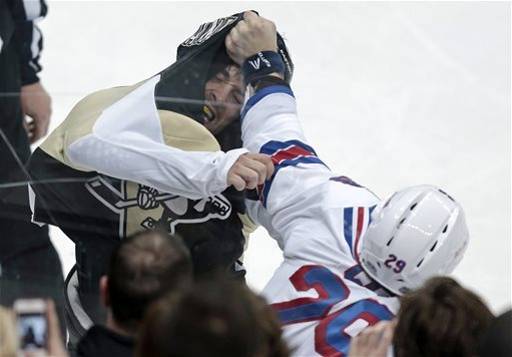
*Engelland was 19-4-1 over his 25 previous fights, including a decision over Clowe in a wild bout last season. The rematch was a good one, with the big guys trading some big punches. It's nice that Clowe accounted himself well but that fight was for Engy. The wise defenseman knew he needed that early bout for his team, to show they weren't going to be smacked down for a second straight game. Seeing as the Rangers didn't exactly set the world on fire in the first 10, it's understandable that Clowe entertained the dance invitation.

*PHW Three Stars:
3-Henrik Lundqvist - 26 saves.
2-Jussi Jokinen - one regulation goal, one shootout goal.
1-Marc-Andre Fleury - 34 saves.

Scotty Hockey Three Stars:
3-Fleury - Not the same sieve that let six past him on Wednesday.
2-Hank - Some quality stops by the King.
1-Jokinen - New team syndrome struck for everyone else who was dealt at the deadline, so it was inevitable. 


 18-15-4: Three Out Of Four Ain't Bad...


In the world of sports, every season is a rollercoaster ride filled with highs, lows, and unforgettable moments. The record of 18-15-4 encapsulates a season in which a team achieved a remarkable feat—winning three out of four games in a crucial stretch. In this article, we will delve into the thrilling narrative of this season, explore the significance of winning three out of four, and answer frequently asked questions to provide a comprehensive understanding of this noteworthy achievement.

I. The Season's Journey

The season began with high hopes and aspirations for the team, as they set out to conquer the challenges that lay ahead. Each game brought its own unique set of trials and triumphs, contributing to the team's overall record of 18-15-4.

Early Season Challenges: The team faced early season challenges, including injuries and adapting to new strategies. These hurdles tested their resilience and determination.

Turning Points: Throughout the season, there were turning points where the team's performance either surged or faltered. These pivotal moments shaped their journey and aspirations.

II. The Crucial Stretch: Three Out Of Four

The turning point of the season came during a critical stretch of games where the team achieved a remarkable feat—winning three out of four contests. This achievement was a testament to their skill, determination, and teamwork.

Stunning Victory: The team began the stretch with a stunning victory that showcased their ability to overcome adversity. It was a game that left fans exhilarated and full of hope.

Building Momentum: The consecutive victories built momentum, fueling the team's confidence and determination. Players were firing on all cylinders, and the chemistry on the ice was palpable.

Resilience in Defeat: Even in their lone loss during this stretch, the team displayed resilience and fought valiantly. It was a testament to their character and refusal to back down.

III. The Significance of Winning Three Out Of Four

Winning three out of four games in this crucial stretch held immense significance for the team and its fans.

Boost in the Standings: The victories catapulted the team up the standings, positioning them as serious contenders in the league. It was a remarkable ascent that invigorated fans.

Confidence and Belief: The wins instilled a sense of confidence and belief in the team's abilities. Players knew they could compete at the highest level and were ready to take on any challenge.

Fan Enthusiasm: Fans celebrated the team's success with boundless enthusiasm, filling arenas with excitement and optimism. The games became a collective experience of joy and celebration.

IV. FAQ: Answering Your Questions

How does a team maintain momentum during a winning streak?

Maintaining momentum during a winning streak requires a combination of physical and mental preparation. Players must stay focused, continue practicing diligently, and not become complacent.
What role does coaching play in a team's success during a crucial stretch of games?

Coaching plays a vital role in strategy development, motivation, and adjustments during games. Coaches provide the guidance and leadership necessary to maximize a team's performance.
Can a team's performance during a crucial stretch impact their chances in the postseason?

Yes, a team's performance during a crucial stretch can significantly impact their postseason prospects. Building momentum and confidence can carry into the playoffs, making them more formidable competitors.
How do fans contribute to a team's success?

Fans contribute to a team's success by providing unwavering support, creating a passionate atmosphere in arenas, and motivating players. Their enthusiasm and loyalty are invaluable.
V. Conclusion

The record of 18-15-4 is a testament to the captivating nature of sports, where every game and every stretch of the season carries the potential for greatness. Winning three out of four games during a crucial period was not just a statistical achievement; it was a manifestation of the team's determination, resilience, and skill.

As fans and enthusiasts relive this remarkable stretch, they are reminded that sports have the power to inspire, unite, and elevate the human spirit. The victories during this period serve as a source of pride, a symbol of hope, and a testament to the enduring magic of competition. In a world filled with challenges, sports stories like this one remind us of the beauty and excitement that can be found on the ice, where teams achieve remarkable feats and inspire us all.


Wednesday, January 13, 2010

22-17-7: Heartbreaker


The Rangers played their best game of the season and came out without a win on Tuesday night, falling 1-0 to the Devils (of all teams) in a shootout. The match had end-to-end action from start to finish and served as a slap in the face to Bettman and the other idiots who insist that the sport of hockey needs more scoring.

As I've pointed out many times in the past: there are good losses and there are bad losses and this was a good one for the Rangers. They earned a point against the top team in the conference despite being unable to break Jacques Lemaire's trap and get more than a handful of actual scoring chances. It was outright painful to see Mmmmaaarrrttyyy be attributed with 55 saves in the game (including the four in the shootout) considering he barely need to break a sweat. Especially as poor Hank was under fire on the other end. The Devils moved with ease into scoring positions to get off good shots but the Ranger defense did quite well to limit second chances.

Notes:

*Anyone else remember the NY/Florida, Richter vs Vanbiesbrouck battle back in the day? I felt like tonight's tilt had a lot of similar qualities ... unfortunately this post-lockout match had to have the shootout instead of ending 0-0.

*It is strange to say but from top to bottom, the Blueshirt blueline was outstanding. Rozsival played his best game as a Ranger since Jaromir Jagr left and even Wade Redden wasn't bad steering rebounds away from the crease.

*Hank made good save after good save as Bergfors, Rolston and Parise sliced through the Ranger zone to get off quality shots. After watching Lundqvist sprawl, dive and butterfly back and forth to make so many stops, it was disappointing that his glove hand was completely frozen as Patrik Elias' game-winner flew by.

*Where the Devil sniper scored, Marian Gaborik tried to be too cute and Mmmmaaarrrttyyy had little trouble stopping him. It was a stark contrast from Gaborik's cut to the net and shot in the OT that trickled past Fatso only to hit the far post. I had a perfect view from my perch in 329 and that was just oh-so-close.

*Vinny Prospal's return was alright but not great. He was clearly rusty and ran out of gas by the overtime. Once he gets the feet back under him, it is clear that he will be a big help, especially with Christensen still playing well (shootout 'attempt' notwithstanding).

*Brian Boyle played to the best of his ability, but his stone hands cost the Rangers a win. How the guy gets a breakaway and doesn't make a move and shoots it right at the opposing netminder is beyond me. He earned some redemption with his physical play late in the third period but the simple fact is that he bricked with the game on his stick.

*Much like Ales Kotalik. That guy is a disgrace. He was brought in for his shot on the power play and his ability in the shootout but he couldn't get a shot off with the man advantage and, for the second straight shootout, completely underwhelmed with his skill competition "effort." Three million dollars a year for three years. If they want to carry a power play and circus sideshow specialist, P.A. Parenteau would be a much cheaper option.

*Why was Donald Brashear dressed when New Jersey scratched Andrew Peters and, with Fatso in net, scoring was sure to be at a premium? Enver Lisin's breakaway speed would have been a bigger boon than anything that was brought by the lumber goon.

*The Avery/Mmmmaaaarrrtttyyy battle never escalated beyond some trash talking behind the plays and occasional contact - reminders to each other that they knew where the other was. Avery did play a good game and got some decent shots on net but Chris Higgins was never there (or able) to finish them off. Arty Anisimov showed he isn't the proper center for those wingers, at least now. The kid needs some more muscle so he can power to the net more often. If he gets that, it will free Avery and Higgins to get the garbage goals instead of it being them constantly trying to work the puck off the boards.

*It would be easy to harp on the officiating missing so many calls early on but at least they didn't go the easy route and make nickel-dime Avery Rule calls all night. For the most part they let the teams play the game and it was much better for it. Of course, the Rangers having to deal with 1:39 of a 5-on-3 was a little stupefying but they miraculously pulled out the kill and injected serious life into the Garden.

*There were a good number of Devil fans scattered around the building but, thankfully for all parties involved, they only came to life after Elias scored to seal the game and even then were a bit subdued.

*The music in the Garden was marginally better than usual but was still a far cry from the fun bands I heard in Fenway.

*Parise, Travis Zajac and defenseman Andy Greene were all outstanding for the Devils. And that is all I will say about that.

*Re-reading this, it comes off as quite pessimistic - like many of my posts - but the game was quite impressive. It was exciting, entertaining and a great time. It was just the result that was heartbreaking. Damned Devils.

*PHW Three Stars
3-Patrik Elias - shootout goal.
2-Henrik Lundqvist - 45 saves.
1-Martin Brodeur - 51 saves.

Scotty Hockey Three Stars
3-Parise - I hate you Hugh Jessiman.
2-Mmmmaaaarrrtttyyy - Ok, so I wasn't impressed with most of his saves but tubby still made them and skated away with the win. Boo.
1-Hank - Could you imagine how good the King would be behind a Lemaire system?


22-17-7: Heartbreaker - Rangers' Rollercoaster Season
The 2023 NHL season has been a rollercoaster ride for the New York Rangers and their loyal fanbase. With a record of 22 wins, 17 losses, and 7 overtime losses, the team has shown moments of brilliance followed by frustrating setbacks. In this article, we'll dissect their season, explore key moments, and answer some frequently asked questions about the Rangers' performance.

The Rollercoaster Season
The Rangers' season can be described as a rollercoaster for several reasons:

1. Hot Starts and Cold Streaks:
The team began the season with a series of strong performances, building optimism among fans. However, they've also endured frustrating losing streaks, leaving fans scratching their heads.

2. Offensive Firepower:
The Rangers boast one of the most dynamic offenses in the league, with stars like Artemi Panarin, Mika Zibanejad, and Alexis Lafrenière lighting up the scoreboard. Their ability to score goals in bunches has been a highlight.

3. Defensive Inconsistency:
On the flip side, the Rangers have struggled with defensive consistency. They've had games where they've allowed too many goals, putting pressure on their high-scoring offense to compensate.

4. Overtime Drama:
The team's 7 overtime losses have provided both excitement and frustration. While they've earned valuable points, these losses have left fans wondering if they can secure the extra point in crucial situations.

5. Playoff Aspirations:
With the Eastern Conference playoff race heating up, the Rangers are in contention, but the margin for error is slim. The team's ability to secure a playoff spot will depend on their performance down the stretch.

Key Moments
Several key moments have defined the Rangers' season:

1. Panarin's Scoring Prowess:
Artemi Panarin continues to be a dominant force, consistently finding the back of the net and setting up his teammates. His offensive brilliance has been a highlight.

2. Goaltending Challenges:
The Rangers have faced challenges in the goaltending department, with Igor Shesterkin dealing with injuries at times. The team's success often hinges on the performance of their netminders.

3. Lafrenière's Development:
Alexis Lafrenière, the first overall pick in the 2020 NHL Draft, has shown flashes of his potential and is gaining valuable experience as he continues to develop.

4. Trade Deadline Decisions:
As the trade deadline approaches, there are questions about whether the Rangers will be buyers or sellers. Decisions made in the coming weeks could shape the team's direction.

Frequently Asked Questions
1. Can the Rangers make the playoffs this season?
Yes, the Rangers are in contention for a playoff spot in the Eastern Conference. Their performance in the remaining games will be crucial.

2. Who are some breakout players for the Rangers this season?
Apart from the established stars, Adam Fox has continued to excel on defense, and Kaapo Kakko has shown growth in his game.

3. What are the team's strengths and weaknesses?
The Rangers' strengths include their potent offense and a strong power play. Their weaknesses include defensive inconsistency and occasional goaltending challenges.

4. What is the fan sentiment surrounding the team this season?
Rangers fans remain passionate and supportive but are eager to see the team secure a playoff spot and make a deep postseason run.

5. Are there any prospects in the Rangers' system to look forward to?
Yes, the Rangers have a promising prospect pool, including Nils Lundkvist, Braden Schneider, and Vitali Kravtsov, who could make an impact in the future.

As the 2023 NHL season progresses, Rangers fans will continue to experience the highs and lows that come with supporting their team. With an offense capable of dazzling performances and a playoff berth within reach, the Rangers have the potential to turn this rollercoaster season into a memorable one.


Wednesday, March 5, 2008

Evaluating The Overtime

After watching the Rangers lose in a shootout to the Islanders last night I got to thinking about how awful it was for a game to be decided in the skill competition. While a fellow Ranger fan pointed out to me that the sloppy play by both teams showed how ties should still be allowed as neither team played well enough to win. But this is not a debate as to whether or not there should be shootouts, but rather is the value of overtime has lessened.

By my math, an astounding 125 out of the 217 extra-time games (as of the games finished on March 4th) have been decided in shootouts. The Edmonton Oilers won 14 of the 17 shootouts they participated in. Having seen a few of their games, after a minute or so into the overtime, they start playing not to lose rather than to win since they have a better chance coming out on top in the one-on-one competition rather than the four-on-four overtime.

And they aren't the only team. The Rangers are one of them as well. Disagree? Then how can you explain them putting slower skaters out on the ice *cough, cough, Marek Malik, cough* when there is more room to skate? Ryan Callahan, the fastest Ranger in yesterday's loss, was relegated to the bench (as was the red hot Nigel Dawes) for the slower - yet more responsible - Brendan Shanahan.

The league initially made overtime 4-on-4 to increase scoring with more room. That clearly is not happening as 58% of games that go beyond regulation remain even. Shootouts are certainly a fan-friendly device to decide games but the brass tacks of it is that hockey becomes an individual sport, which it is not. The shootout certainly isn't going to go away, so what is the solution?

Rather than turning to the idea of 3-on-3 play, how about a change to the offside rules? The league could make it a carry-over offsides where a player can already be in the offensive zone as long as the puck is carried over the blueline or can get rid of the blue line entirely. Do these sound familiar? They should, at least for folks who play(ed) roller hockey. There was a lot more scoring in Roller Hockey International and that wasn't necessarily a symptom of lesser-quality players. Having lax offsides rules opens up the ice surface even farther and allows longer home run passes and even cherry picking. The latter has some negative connotations but shouldn't.

Say a team wants to send one of their guys to camp out at the far crease. If the other team leaves a defender there, then its a 3-on-3 situation in the zone. If they leave the player alone with the goaltender, then its a 4-on-3 in deep. Say the three are able to get the puck out, then the goaltender can try to come out of his crease to challenge the goal hanger or stop the home run pass, which increases the odds of a good scoring chance even farther.

If the five minute extra period still doesn't produce a winner, then you can still have the skill competition declare a winner, but I would rather see games ended based on team play rather than individual. And by changing up the offsides, that increases those odds.


 Evaluating Overtime in the NHL: Strategies, Stats, and Excitement


Overtime in the NHL is a thrilling and often heart-pounding spectacle. In this article, we'll delve into the world of NHL overtime, exploring its strategies, statistical trends, and why it continues to captivate fans worldwide.

FAQ 1: How Does NHL Overtime Work?

In regular-season NHL games, if the score is tied at the end of regulation, teams play a sudden-death overtime period. Overtime features three-on-three play for a maximum of five minutes. If no goal is scored, the game proceeds to a shootout.

Strategies in NHL Overtime:

Puck Possession: Possessing the puck is paramount in overtime. Teams often prioritize controlled entries into the offensive zone.

Line Selection: Coaches choose lines that combine speed, skill, and chemistry, given the open ice in three-on-three play.

Defensive Responsibility: While offense is crucial, teams must remain defensively responsible to prevent odd-man rushes.

FAQ 2: Overtime Stats and Trends

Let's explore some interesting statistics and trends in NHL overtime:

Shootout vs. Overtime Goals: Overtime goals are often seen as more legitimate victories than shootout wins. Teams tend to value the extra point from an overtime win over a shootout win.

Goalie Performance: Goaltenders play a crucial role in overtime. Some goalies excel in three-on-three situations, while others struggle. This disparity can influence team strategies.

Early vs. Late Goals: Statistically, more goals are scored early in overtime, often within the first two minutes. Teams may be more aggressive at the start to secure the win quickly.

Home Advantage: Historically, home teams have a slight advantage in overtime. Familiarity with the home arena's layout and last change privileges can make a difference.

FAQ 3: Memorable Overtime Moments

NHL overtime has delivered countless unforgettable moments:

Stanley Cup Winning Goals: Overtime goals in the Stanley Cup Final, like Bobby Orr's famous "Flying Goal" in 1970, are etched in hockey history.

Playoff Heroics: Players like Patrick Kane and Martin St. Louis have made their mark with clutch overtime goals in the playoffs.

Longest Overtime: The longest NHL playoff game went into six overtime periods in 1936. Mud Bruneteau of the Detroit Red Wings scored the game-winner after 116 minutes and 30 seconds of overtime.

FAQ 4: Evolution of Overtime Formats

The NHL has experimented with overtime formats over the years:

Five-Minute Overtime: Prior to the 1983-84 season, ties were common in the NHL. Overtime was introduced to reduce the frequency of ties.

Four-on-Four: From 1999-2000 to 2015-16, four-on-four overtime was used. This format aimed to create more open ice and increase scoring.

Three-on-Three: In 2015-16, the current three-on-three format was introduced to maximize excitement and reduce the number of shootouts.

FAQ 5: Shootout vs. Overtime: Fan Opinions

The shootout, introduced in the 2005-06 season, remains a polarizing aspect of NHL overtime. Some fans love the one-on-one drama it creates, while others prefer the purity of overtime play.

Shootout Fans: Supporters argue that shootouts add a unique, skills-based element to the game and provide closure to games without a clear winner.

Overtime Purists: Purists believe that shootouts can be anticlimactic, favoring a return to more extended overtime play to determine a winner.

: Overtime's Enduring Allure

NHL overtime remains a captivating facet of the game, combining skill, strategy, and heart-pounding moments. Whether it's the thrill of a breakaway in a shootout or the sheer chaos of three-on-three play, overtime continues to keep fans on the edge of their seats. As the NHL evolves, so too will its approach to overtime, but one thing remains certain: the excitement it generates will endure for generations of hockey fans to come.